
Condo & HOA Management Insights
Your Condo Concierge Shouldn't Spend Hours Typing Package Labels
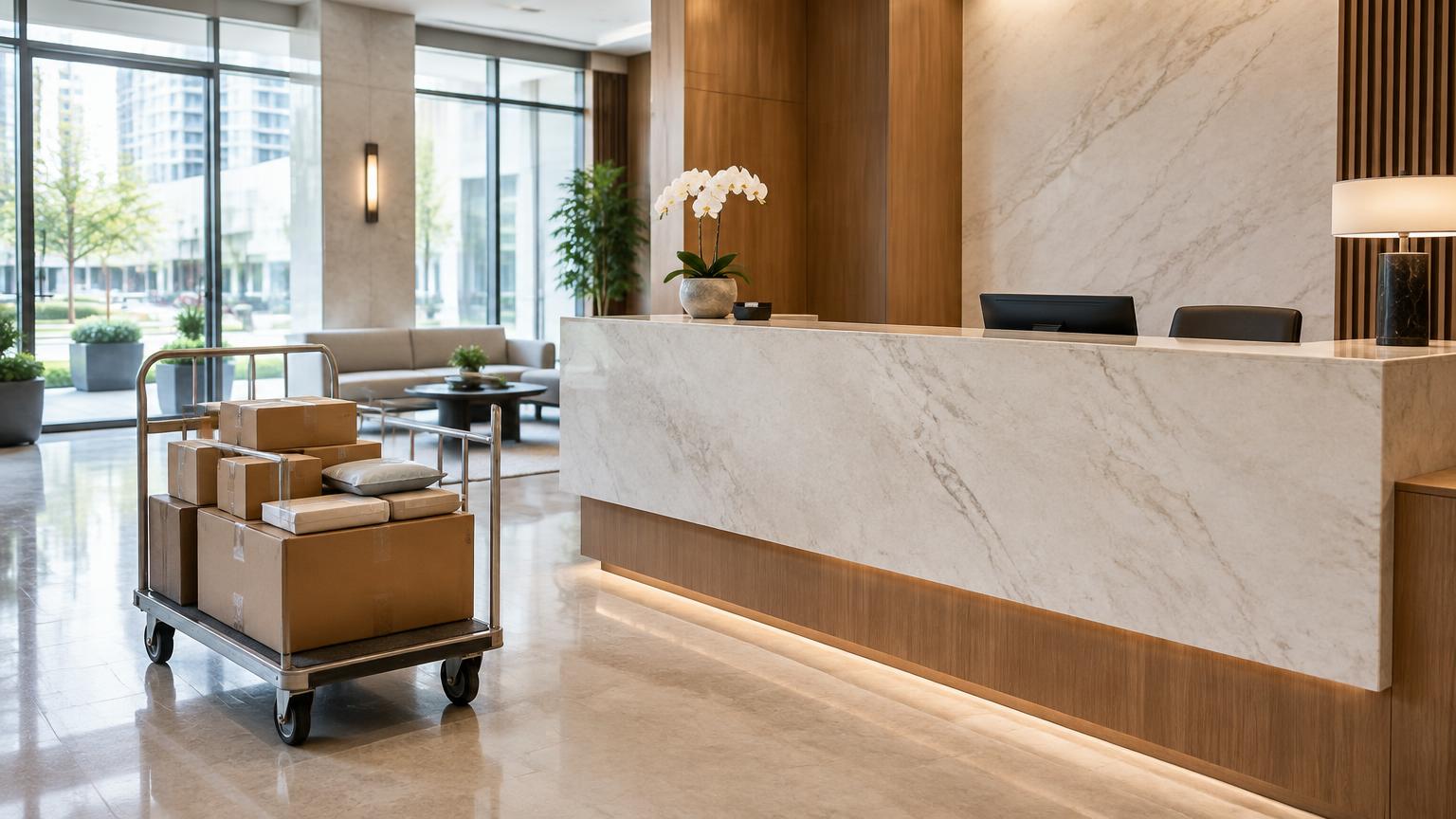
As package deliveries increase, condo buildings face a growing operational challenge. But the answer may not be additional staffing, larger mailrooms, or bigger budgets.
It's 2:00 PM on a Tuesday.
A delivery driver arrives at your condominium with 40 packages.
Your concierge begins sorting boxes, reading shipping labels, looking up residents, entering tracking numbers, and sending pickup notifications.
Meanwhile, residents are arriving, visitors need assistance, contractors are waiting for access, and the phone is ringing.
The concierge is busy. Very busy.
But here's the question every condominium board and property manager should be asking:
How much of your building's staffing budget is being spent on work that doesn't actually require a person?
The Hidden Cost of Package Deliveries
Package deliveries have become a permanent part of condominium operations.
In a 2018 survey of more than 2,000 U.S. apartment communities, the National Multifamily Housing Council found that communities received approximately 150 packages per week on average, rising to roughly 270 during the holiday season.
And that was back in 2018.
Today, managing deliveries is a routine responsibility for many condominium front desks.
Consider a hypothetical building receiving 100 packages per day.
If manually registering each package takes 60 seconds, that's 100 minutes of staff time daily.
Over a year, the numbers become surprisingly significant.
| Manual package logging | Staff time |
|---|---|
| Per day | 1.7 hours |
| Per month (30 days) | 50 hours |
| Per year (365 days) | 608 hours |
At an illustrative loaded staffing cost of $30 per hour, that's approximately $18,250 worth of staff time annually spent registering packages.
And that's just one administrative task.
It doesn't include searching for misplaced deliveries, answering resident inquiries, sending reminders, or resolving disputes.
For a condominium board trying to manage rising operating expenses, these inefficiencies deserve attention.
The Real Problem Isn't Your Concierge
When a front desk becomes overwhelmed, the conversation often turns to staffing.
Do we need another concierge during busy hours?
Should we increase coverage during the holidays?
Is the building growing beyond our current staffing capacity?
These are reasonable questions.
But they assume that every task being performed requires human attention.
It doesn't.
Reading a shipping label, identifying a unit number, entering a tracking code, and preparing a notification are repetitive administrative activities.
Your concierge should be managing the building, not spending hours copying information from cardboard boxes into a computer.
The opportunity isn't necessarily to reduce staff.
It's to give existing staff more capacity to do the work that matters.
What If Logging Packages Took Seconds Instead of Minutes?
Imagine the same delivery of 40 packages arriving at the front desk.
Instead of manually typing every label, the concierge simply takes a picture.
The system reads the label, identifies the recipient, matches the resident to the building directory, and prepares the package record.
The concierge reviews the information and confirms it.
The resident receives a pickup notification.
Then the concierge moves to the next package.
This isn't a futuristic concept.
It's already happening in condominium buildings using Max Condo Club.
Concierge staff using the platform have reported spending 80–90% less time logging packages, based on their experience rather than a formal time study.
That changes the economics of a busy front desk.
If a building currently spends 608 hours annually registering packages, an 80% reduction would free approximately 486 hours.
That's approximately 486 hours that can be redirected toward residents, security, visitors, and building operations.
Not necessarily approximately 486 hours of payroll savings, but something potentially more valuable: additional operating capacity without increasing headcount.
Approximately 486 annual staff hours potentially freed
Hypothetical calculation: 100 packages per day, 60 seconds each, 365 days; 80% reduction applied to the rounded 608-hour baseline. Staff capacity, not guaranteed payroll savings. The 80–90% reduction is concierge-reported, not a controlled time study.
Fewer Complaints Start With Better Accountability
Time isn't the only cost of manual package handling.
Consider what happens when a resident reports a missing delivery.
The property manager asks the concierge to investigate.
Staff search the package room, review the log, check whether another resident collected it, and sometimes examine security footage.
A simple delivery can turn into multiple emails, phone calls, and frustrated residents.
The real issue is often not the missing package itself.
It's the lack of reliable information.
A well-managed package process should answer three questions immediately:
- When did the package arrive?
- Who was it registered to?
- When was it collected, and who signed for it?
With Max Condo Club, package records can include the original label photo, registration details, pickup time, and a signed collection record.
Staff can search by resident, unit, or tracking number.
That gives managers a much clearer starting point when investigating a complaint.
And importantly, AI-assisted registration doesn't mean blindly trusting the computer. When a recipient match is ambiguous, staff are asked to verify it rather than letting the system guess.
The Bigger Opportunity: Running a More Efficient Condominium
Package management is just one example of a larger operational challenge.
Across condominium buildings, valuable staff time is consumed by small, repetitive administrative tasks.
A package needs to be registered.
An amenity reservation needs to be recorded.
A service request needs to be routed.
A resident needs to be notified.
Individually, none of these activities seems particularly expensive.
But multiplied across hundreds of residents, thousands of interactions, and an entire year, they become a meaningful part of a building's operating workload.
For boards, the opportunity is to improve service without automatically increasing operating expenses.
For property managers, it's to reduce the administrative burden on teams that are already stretched thin.
And for residents, it's a building that feels more organized, responsive, and professionally managed.
The best operational improvements are often the ones residents barely notice because everything simply works.
Three Questions Every Condo Board Should Ask
Before approving additional administrative staffing or accepting rising operating costs, boards should ask:
1. Where is our staff's time actually going?
Identify repetitive tasks that consume hours every week. Package registration is a useful place to start because the volume is measurable.
2. Are we solving workload problems with people when technology could help?
Not every increase in workload requires an increase in staffing. Sometimes the process itself needs to change.
3. Can we measure the improvement?
Track how long tasks take before and after implementing a better process. Measure package volume, time spent registering deliveries, and the number of resident inquiries.
A better process should produce a measurable operational improvement, not simply introduce another piece of software.
A Better Building Doesn't Always Require a Bigger Budget
Condominium boards face constant pressure to balance service quality with financial responsibility.
Property managers are expected to do more with limited resources.
And concierge teams are often caught in the middle.
The solution isn't to make people work harder.
It's to remove unnecessary work.
Modern technology can handle much of the repetitive administration that consumes staff time, while keeping people responsible for the decisions and interactions that matter.
That's the philosophy behind Max Condo Club.
Before your building spends more money managing the same workload, find out how much of that workload could be eliminated.
See What Your Building Could Save
Max Condo Club helps condominium managers streamline package registration, resident notifications, and other everyday building operations.
Bring a few real package labels to a 15-minute demonstration and see how AI-assisted registration works with your building's residents.
Discover how AI-assisted package registration can help your concierge spend less time on repetitive data entry and more time serving residents.
Source: National Multifamily Housing Council and Kingsley Associates, 2018 Package Delivery Survey. The staffing calculations above are illustrative, not measured customer savings. The 80–90% logging-time reduction is based on concierge staff reports, not a controlled time study.